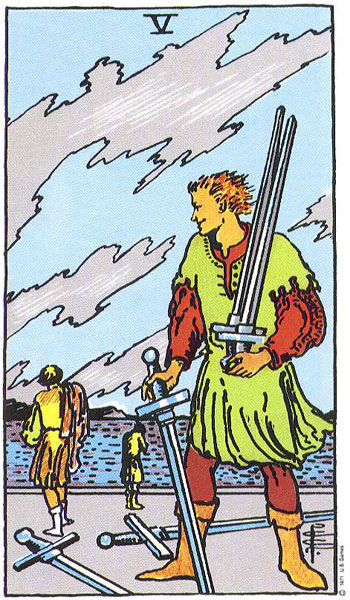
Five of Swords
A man gathers up swords with a smirk while two figures walk away, heads down, in a wind-torn sky. The Five of Swords is the card of conflict and its price — a fight someone "won" that left everyone poorer. It asks a sharp, useful question: is being right worth what it's costing you?
Symbolism & Correspondences
- Names of the card
- Lord of Defeat; the Hollow Victor; the Cost of Winning
- Number
- 5 — the disruption of the stable four: conflict, loss and the friction of clashing wills
- Element
- Air
- Astrology
- Venus in Aquarius — connection turned cold and detached; harmony sacrificed to being right
- Astrological house
- 3rd house — the mind's suit at war with itself and others; the sharp edge of words
- Occult essence
- Defeat — the win that costs more than it gains; a battlefield where even the victor stands alone
- Mythology
- The Pyrrhic victory — one more such win and we are undone; the fight that empties the winner
«Ask whether this is a hill worth the cost of taking»
Meaning
Upright, the Five of Swords is discord — an argument, a clash of wills, a win that turned out hollow. Someone came out on top, but the picture is bleak: relationships strained, resentment left in the air, a victory that feels more like a loss. The card doesn't take sides so much as show the aftermath. Even the man collecting the swords stands alone.
It holds up an honest mirror. Sometimes you're the one who won the argument and lost the goodwill; sometimes you're the one walking away, choosing to lose the fight rather than pay its price. The Five asks whether the battle in front of you is worth winning — because some victories cost far more than the thing you fought over. Occasionally the wisest strength is to put the sword down and walk.
In Love
In love, the Five of Swords is conflict that leaves a mark — a fight where winning mattered more than understanding, words that scored points but drew blood, a power struggle nobody actually wins. Notice the cost: is being right about this worth the distance it's creating? Sometimes protecting the relationship means letting the argument go unwon — and sometimes it means recognising a dynamic that's become all friction.
In Career
At work, the Five of Swords is office conflict and win-at-all-costs politics. It can mark a clash where you triumphed but burned a bridge, or a hostile environment where everyone's fighting and no one's building. The card warns against hollow wins — the point scored at the cost of the team. Pick your battles ruthlessly: some are worth it, and many are traps.
Money & Material Life
In money, the Five of Swords is a costly dispute — a financial disagreement fought over until the winning wasn't worth it, a stubbornness that ends up more expensive than compromise. It warns against "winning" a money argument at the cost of a relationship or a future opportunity. Weigh the real total cost of being right, not just the immediate gain.
Well-being & Energy
For well-being, the Five of Swords is the toll of conflict on body and mind — the tension of ongoing friction, the low-grade stress of a fight that won't resolve, the drain of carrying resentment. It gently suggests that some battles are quietly costing you your peace. Letting go of a conflict you can't win, or don't need to, is often more healing than pushing to win it.
Reversed Meaning
Reversed, the Five of Swords usually leans toward repair — the desire to make amends, put down the grudge, reconcile after a fight that went too far. It marks a turn away from conflict: forgiveness offered or received, a bridge rebuilt, the choice to stop keeping score.
It can also deepen the conflict or signal a refusal to let go — a resentment nursed long past its usefulness. If that's the read, ask what holding the grudge is really protecting. Releasing it isn't losing; it's reclaiming the energy the fight has been draining.
In Combinations
- •Five of Swords + Justice — a conflict where fairness is the real question: win it clean and fair, or the victory won't hold.
- •Five of Swords + The Devil — a fight driven by ego or a need to dominate: notice what's really fuelling this before it consumes you.
- •Five of Swords + The Tower — a clash that blows something apart: the fallout is bigger than the argument; count the cost before you commit.
- •Five of Swords + Seven of Swords — a conflict fought with hidden tactics: someone isn't playing straight; name it plainly instead of matching it.
Advice of the Card
Before you fight to win, ask what winning will actually cost you — some hills aren't worth the climb. Choose your battles over proving your point.
Caught in a conflict and unsure whether to push or let go? Ask the cards about your situation:
Get my personal reading